Rail Diagnostics: The Secret Life of Steel Tracks..

Steel rails endure immense stress and wear. Modern rail diagnostics detect hidden defects early, preventing breakdowns and derailments. Let’s explore how technology keeps trains safe and on track! 🚆

 · 2 min read

Asset Integrity Series

Rail Diagnostics:
The Secret Life of Steel

Beyond the surface: Understanding sub-surface defects, Rolling Contact Fatigue (RCF), and the transition toward predictive rail maintenance.

Diagnostic Vectors
  • Ultrasonic Flaw Detection (USFD)
  • Eddy Current Testing
  • Magnetic Flux Leakage (MFL)
  • Vision-based Surface Scan

Diagnostic Systems
Reliability Metric

Modern rail management targets a **Zero Fracture** goal by shifting from reactive visual inspections to data-driven **Condition Based Maintenance (CBM)**.
NON-DESTRUCTIVE TESTING (NDT) ASSET INTEGRITY

1.0 The Lifecycle of Rail Fatigue

Railway tracks are engineered to be resilient, yet they are subject to extreme cyclical loading. Over time, the interaction between the wheel and the rail induces Rolling Contact Fatigue (RCF). This manifests as sub-surface cracks that propagate through the rail head, potentially leading to catastrophic structural failure if not detected via advanced diagnostic protocols.

2.0 Taxonomy of Defects (The Usual Suspects)

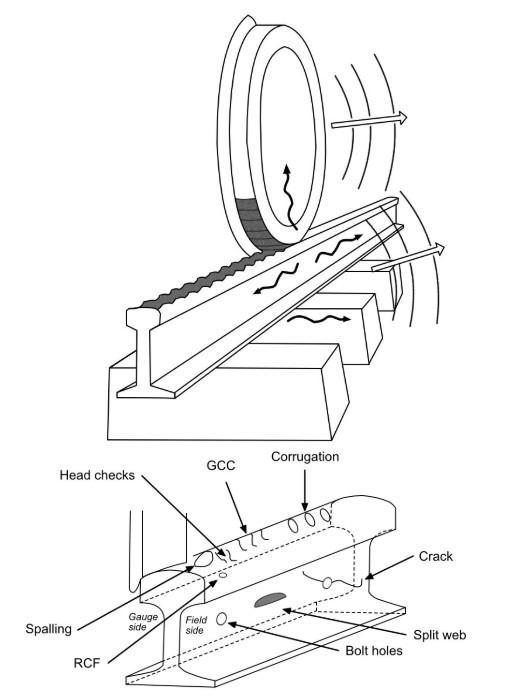
Rail Defect Mapping

Figure 1.1: Common sub-surface and surface rail morphology.

Head Checks & Shelling

Fine, closely spaced cracks at the gauge corner. If unchecked, these lead to shelling—where metal segments detach from the rail head.

Squats & Wheel Burns

Localized depressions caused by plastic deformation or wheel slip. These act as stress concentrators for internal fractures.

Internal Transverse Fissures

The "silent killer" of rail. These cracks grow perpendicular to the rail length and are invisible to the naked eye.

Rail Corrugation

Periodic wavy deformations causing high-frequency vibrations, accelerating the wear of both track and rolling stock components.

3.0 Proactive vs. Reactive Paradigms

Traditional maintenance was purely Reactive: fixing rails only after a fracture occurred. Modern diagnostics utilize a Predictive approach, leveraging high-speed scanning to identify the "Pre-failure" state.

"The goal of rail diagnostics is not to find broken rails, but to identify the cracks that will break them in 6 months."

4.0 The Future: AI & Continuous Monitoring

The next frontier in rail integrity involves the integration of Inertial Measurement Units (IMUs) and Big Data Analytics. By analyzing the "rhythmic clatter" through vibration sensors, AI algorithms can now pinpoint sub-surface anomalies before they reach critical limits.

Continuous Inspection Systems

Trackomatic is leading the transition with automated diagnostic trolleys and vehicle-mounted sensors that allow for inspection without disrupting revenue traffic.

Modernize Your Inspection

Protect your infrastructure with TIPL's high-precision rail flaw detection toolsets.

View Diagnostic Range

No comments yet.

Add a comment
Ctrl+Enter to add comment